
The Epidemiological Paradox: Why Cancer Deaths Are Surging While Risk Is Falling
Deconstructing 30 years of global health metrics (1990–2019): How demographic aging masks clinical progress and why raw counts distort public health policy.
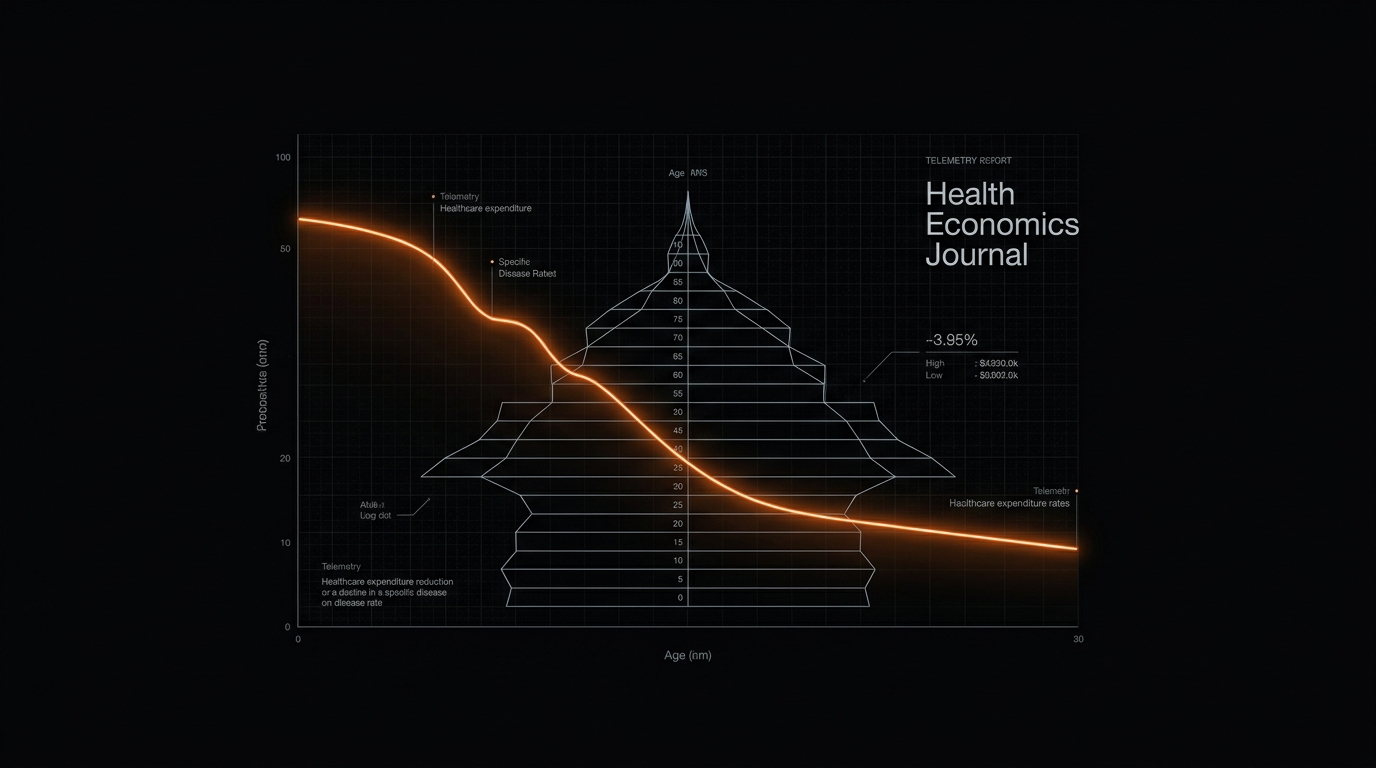
"Public panic over rising absolute cancer fatalities conflates demographic longevity with medical stagnation. Across 281.4k empirical records spanning 1990–2019, age-standardized mortality fell by 15.2%, proving that therapeutic innovation is winning against biological aging—if healthcare systems can bridge severe diagnostic inequality."
The Epidemiological Divergence Model (2019)
💡 The Simpson's Paradox Diagnosis: While total cancer deaths climbed from 5.52M to 9.67M due to global life expectancy gains doubling the senior population (328M ➔ 703M), the individual age-standardized mortality risk declined by -15.22% (147.9 ➔ 125.4 per 100k).
The Headline Panic: When Raw Counts Mislead
Every few years, global health reports publish staggering headlines: *"Cancer deaths reach record high of 9.67 million"*, or *"Global cancer mortality has jumped 75% over the past three decades"*.
To the casual observer and policy planner, these statistics paint a bleak picture of an escalating global oncology crisis—a narrative of biomedical failure where trillions of dollars invested in genomics, immunotherapy, and targeted oncology seem to yield diminishing returns.
Except the narrative is fundamentally wrong.
When we examine the empirical longitudinal data across 281,440 panel records from the *Institute for Health Metrics and Evaluation (IHME)*, *Our World in Data*, and the *CONCORD-3 Global Surveillance Programme* spanning 1990 to 2019, a profound mathematical paradox emerges:
| Global Health Metric (1990–2019) | 1990 Baseline | 2019 Baseline | 30-Year Delta | Clinical & Demographic Reality |
|---|---|---|---|---|
| Global Absolute Cancer Deaths | 5.52 Million | 9.67 Million | +75.3% | Driven by demographic longevity expansion |
| Global Population (Billions) | 5.32 Billion | 7.71 Billion | +44.9% | General global population growth |
| Population Aged ≥65 Years | 328 Million | 703 Million | +114.3% | Senior cohort more than doubled worldwide |
| Age-Standardized Death Rate (ASDR) | 147.93 / 100k | 125.41 / 100k | -15.2% | Individual biological risk falling significantly |
The absolute number of human beings succumbing to malignant neoplasms expanded by +75.32%, yet the individual, age-adjusted biological risk of dying from cancer plummeted by -15.22%.
How can cancer deaths surge by millions while society is simultaneously becoming safer from cancer than at any point in modern history?
The Confounding Force: Demographic Longevity
The answer lies in demographic aging—the ultimate confounding variable of global health analytics.
Cancer is fundamentally an age-associated disease. Cellular DNA accumulates stochastic oncogenic mutations, epigenetic alterations, and telomere shortening over decades. The risk of developing an invasive carcinoma at age 75 is more than 40 times higher than at age 25.
The Longevity Escalation Chain:
1. Public Health Victories: Suppressing childhood mortality and infectious disease extended average life spans worldwide.
2. Senior Cohort Doubling: The global population aged 65+ grew from 328M to 703M (+114.3%).
3. Cellular Vulnerability: Cancer risk rises exponentially with chronological age due to cumulative DNA damage.
4. The Net Metric Divergence: Absolute fatalities surged (+75.3%), while individual age-adjusted risk plummeted (-15.2%).
Between 1990 and 2019, humanity achieved extraordinary success in suppressing infant mortality, infectious pathogens, and cardiovascular catastrophes. As a direct consequence, the global population over age 65 doubled from 328 million to 703 million (+114.3%).
When millions of additional human beings survive past their 70th birthday, the pool of individuals biologically vulnerable to oncogenesis expands exponentially.
If we evaluate cancer burden purely through raw, unadjusted counts, we fall into a classic Simpson’s Paradox in macro-health policy: penalizing modern oncology for the very demographic success of global public health.
Decomposing the True Engine of Progress: ASDR
To evaluate whether medicine is genuinely progressing, epidemiologists rely on the Age-Standardized Death Rate (ASDR), calculated by weighting observed age-specific mortality rates against a synthetic standard world population structure:
Mathematical Notation Guide:
- Dᵢ: Observed cancer fatalities within specific age cohort i (e.g. ages 50–54, 70–74).
- Pᵢ: Total global population residing in age cohort i.
- (Dᵢ / Pᵢ): Age-specific crude mortality rate for cohort i.
- Wᵢ: Standardized WHO world demographic weight for cohort i.
- 100,000: Standardized epidemiological rate constant per 100,000 population.
When this mathematical normalization is applied to 30 years of panel data:
- Universal Declines Across Developed Registries: In the United States, Western Europe, and Australasia, cancer ASDR has dropped by 25% to 32% since 1990, driven by aggressive anti-tobacco legislation, early colonoscopy screenings, and adjuvant chemotherapies.
- Clinical Survival Surges (CONCORD-3): 5-year relative survival for localized Breast Cancer exceeds 88–92% across 30+ nations; Prostate Cancer exceeds 95%; and childhood acute lymphoblastic leukaemia has transformed from a near-certain fatal diagnosis in 1970 into an 85%+ curative condition today.
The Real Crisis: Geographic and Socio-Economic Disparity
If the global biological risk is declining, where does the real crisis reside?
The real failure is not therapeutic stagnation—it is structural diagnostic and economic inequality. When we analyze cross-national data across 204 sovereign nations in 2019, the global mean ASDR (125.4 per 100k) fragments into extreme regional clusters:
| Country / Region Cluster | ASDR (Deaths / 100k) | Primary Etiological & System Driver | Clinical Status |
|---|---|---|---|
| Hungary *(Global Highest #1)* | 208.5 | Heavy historical tobacco & alcohol synergy | High mortality belt |
| Serbia *(Rank #2)* | 198.9 | High smoking prevalence & late-stage clinical diagnosis | Urgent screening need |
| Slovakia *(Rank #3)* | 191.5 | High colorectal, gastric & lung neoplasm burden | Elevated risk |
| Eastern European Mean | 182.4 | Post-Soviet healthcare infrastructure transition | Regional crisis |
| Western European Mean | 121.2 | Universal screening, early colonoscopy & adjuvant therapy | Managed baseline |
| East Asia *(Japan / S. Korea)* | 98.6 | Universal endoscopic gastric screening programs | High survival tier |
| Sub-Saharan Africa *(Reported)* | 84.2 | Severe pathology shortages & cancer registry latency | Diagnostic reporting gap |
1. The Eastern European High-Mortality Belt
Sovereign nations in Eastern Europe (Hungary, Serbia, Slovakia, Montenegro) experience cancer death rates exceeding 190–208 per 100k—over 65% above the global average. This is not genetic bad luck; it is an etiological consequence of heavy historical smoking rates (where tobacco still drives 24.7% of all cancer fatalities globally), high alcohol intake, and fragmented post-Soviet oncology screening programs.
2. The Low-Income "Diagnostic Desert" Illusion
Conversely, developing nations in parts of Sub-Saharan Africa and South Asia report deceptively low official cancer death rates (e.g. < 85 per 100k).
Our econometric scatter analysis of GDP per Capita ($PPP) vs Cancer Mortality across 186 nations reveals a non-linear paradox: as nations transition from low-income to upper-middle income, recorded cancer rates initially *rise*. Why? Because low-income populations suffer from registry absence and diagnostic latency: thousands die of undiagnosed neoplasms misclassified as respiratory infections or systemic organ failure before an oncologist ever examines a tissue biopsy.
5 Principles for Pragmatic Health Analytics
To prevent data distortions from misleading health resource allocations, analytics leaders and policymakers must adopt 5 guardrails:
1. Mandate ASDR Over Raw Counts in Policy Debates
Demographics will naturally push absolute cancer diagnoses toward 15 million by 2040. Public policy and resource allocation must use age-standardized rates to separate demographic swelling from clinical therapeutic efficacy.
2. Decouple Etiology Prevention from Clinical Performance
High cancer incidence is a regulatory and preventive challenge (tobacco taxation, ultra-processed diet, HPV vaccination). High case fatality is a delivery failure. Conflating the two paralyzes health ministries.
3. Treat Cancer Registries as Critical Infrastructure
High-income nations achieve superior cancer survival because population-based registries (such as SEER in the US or NCIN in the UK) detect stage-I neoplasms where 5-year survival is 6x higher than stage-IV presentation.
4. Target the Global Survival Heterogeneity Gap
As proven by CONCORD-3 data, the gap between a 90% breast cancer survival rate in North America and a 45% survival rate in low-income nations is not a mystery of molecular biology—it is a solvable logistics problem of mammography access, generic pathology reagents, and timely radiotherapy.
5. Contextualize Historical Data Windows
Every longitudinal dataset reflects a distinct historical era. The 1990–2019 baseline captures the golden era of demographic expansion and tobacco reduction, setting the rigorous benchmark against which post-pandemic healthcare disruptions must be evaluated.
Conclusion: The Rational Optimism of Data
Cancer remains one of humanity's most formidable biological adversaries. But looking at the data through rigorous epidemiological lenses reveals a clear verdict: biomedical science is winning the war against premature cancer mortality.
The true challenge for the next three decades is not inventing miracle molecules in ivory towers; it is the engineering of global healthcare logistics—ensuring that the diagnostics, screening protocols, and prevention policies that cut age-standardized cancer deaths by 15.2% in wealthy nations are deployed universally to every hospital, registry, and clinic on earth.